


 Spanish
 Russian
 Arabic


Products Description
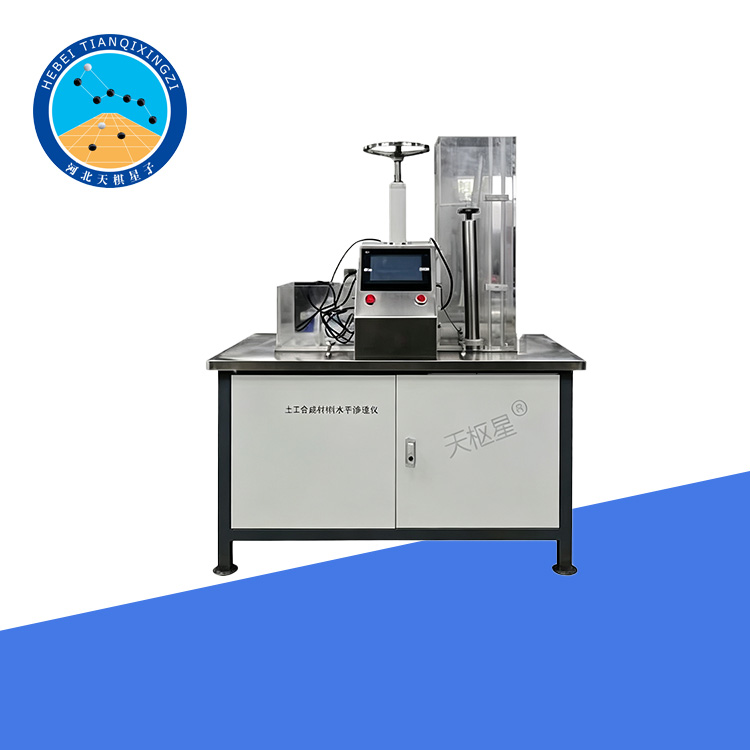
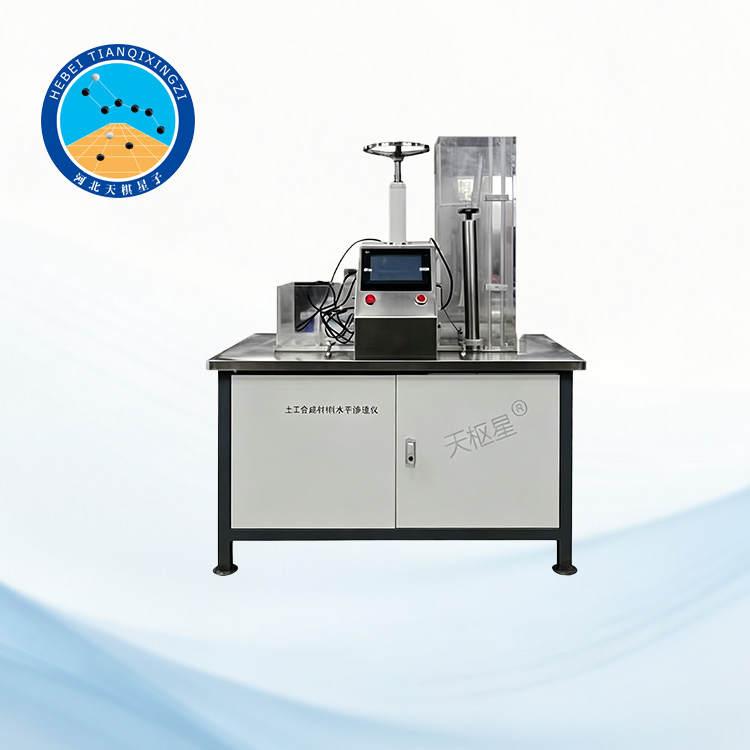
The Geotextile In-Plane Water Flow Tester is designed to determine the in-plane water flow capacity, permeability coefficient, and hydraulic transmissivity of geotextiles under specified normal pressure and constant hydraulic head conditions. It is suitable for evaluating the drainage and water transmission performance of geotextiles and geosynthetic materials, with stable performance and reliable test results.
Geotextile In-Plane Water Flow Tester
Model:TD17633-1
I. Product Overview
This instrument is developed and designed in accordance with the relevant requirements of GB/T 17633-1998, SL/T 235-2012, ISO/FDIS 12958-98E, and GB 17642-2008, Geotextiles and Geotextile-Related Products — Determination of Water Flow Capacity in the Plane of the Geotextile.
It is suitable for determining the in-plane permeability coefficient and hydraulic transmissivity of geotextiles under a specified normal pressure and constant hydraulic head. The instrument features stable performance, reliable operation, and convenient use.
II. Technical Parameters
1. Sample Size: 100x200mm
2. Normal Pressure Range Applied to the Sample: 10-250kPa
3. Overall Dimensions: 600x1200x1500mm
4. Machine Weight: 150kg
III. Operating Procedures
1.
1) The test water should be degassed water or distilled water.
2) Cut 3 samples each for the knitting direction and the transverse direction. When the samples are thin, 2 or 3 layers of samples should be stacked together for testing. In this case, 6 or 9 samples should be cut accordingly.
2.
1) Enclose the sample in a latex film or rubber sleeve. The sample should be flat and wrinkle-free,
with no leakage around the perimeter. For direct-loading types, carefully install the upper and lower pads of the sample to ensure the sample bears uniform normal pressure.
2) Apply a pressure of 2-5 kPa to position the sample. Immediately inject degassed water into the water level container to remove air bubbles from the sample. The sample should be saturated during the test.
3) Select the hydraulic gradient according to site conditions. When the situation is unclear, choose a hydraulic gradient no greater than 1.0.
4) Select at least three pressure tests based on site conditions or design requirements, one pressure slightly higher than the design value and one slightly lower than the design value. Apply the minimum normal pressure to the sample for 15 minutes. Raise the water level in the container to reach the required hydraulic gradient. After the water flow stabilizes, measure the time it takes for 500 cubic centimeters of water to seep through, or record the amount of water that passes through within 15 minutes. Perform three parallel measurements for each hydraulic gradient.
5) Repeat the above steps with a different hydraulic gradient.
6) Increase the normal pressure and repeat the above steps to complete the tests for the remaining normal pressures.
IV. Test Principle
The Geotextile In-Plane Water Flow Tester determines the water flow capacity of a geotextile in the plane of the material under a specified normal pressure and hydraulic gradient. During the test, the specimen is saturated with water and subjected to controlled normal pressure. Water is then allowed to flow through the specimen along its plane under a constant hydraulic head. The water flow rate is measured after the flow reaches a stable condition.
The test results can be used to evaluate the in-plane water transmission performance, permeability coefficient, and hydraulic transmissivity of geotextiles under different normal pressure conditions.
V. Key Features
1. Designed for in-plane water flow testing of geotextiles and related geosynthetic materials.
2. Supports testing under a wide range of normal pressures from 10 to 250 kPa.
3. Constant-head testing method provides stable and repeatable test conditions.
4. Suitable for evaluating water transmission and drainage performance under different pressure conditions.
5. Test procedures can be performed at different hydraulic gradients according to applicable standards and project requirements.
6. Suitable for laboratory research, quality control, product development, and performance evaluation of geotextiles.
