


 Spanish
 Russian
 Arabic

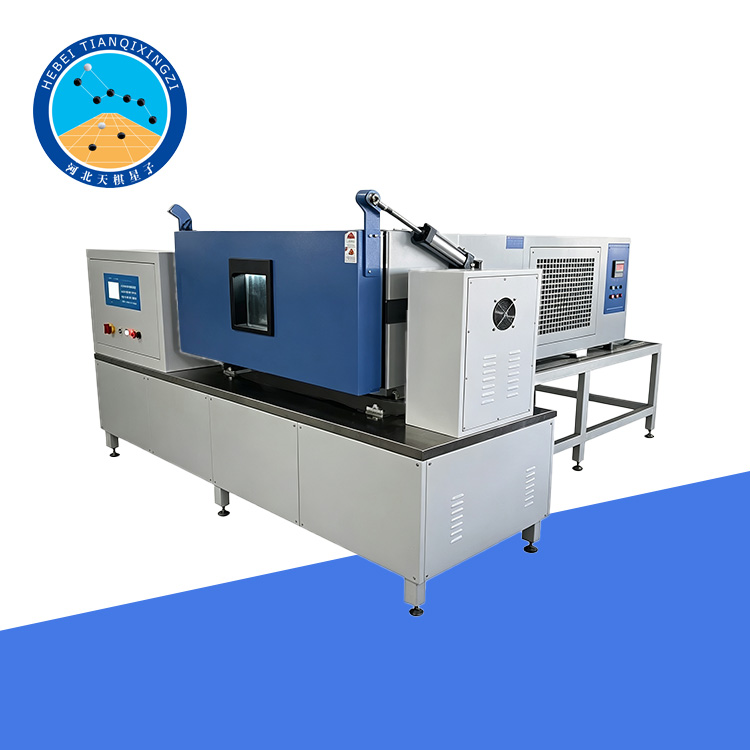

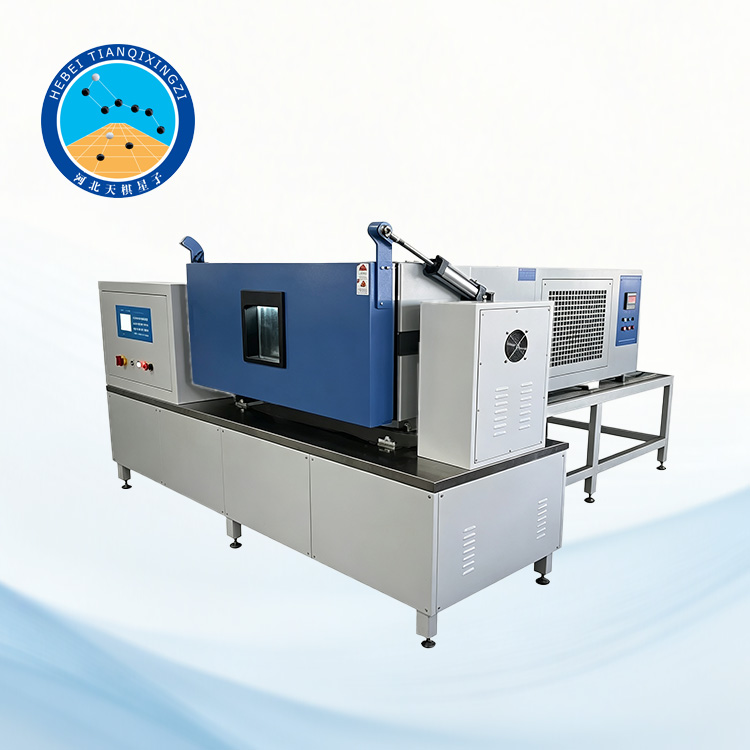
Products Description
This tester is designed to determine the tensile creep and tensile creep rupture behavior of geotextiles and related geosynthetic products. It is suitable for evaluating products whose premature failure or creep deformation may reduce their reinforcing performance and potentially lead to structural instability or collapse.
Geosynthetic Tensile Creep and Rupture Tester
Model: TD1131-4
I. Product Introduction
The Geosynthetic Tensile Creep and Rupture Tester is developed and manufactured by our company in accordance with the Chinese industry standard **JTG E50-2006 *Test Methods of Geosynthetics for Highway Engineering, specifically **T 1121-2006 *Test Method for Tensile Creep and Tensile Creep Rupture Behavior.
Reference Standards: ISO 13431:2024, ASTM D5262-21 (2026)
The system consists of three main parts: a data acquisition and processing unit, a lever-and-weight loading system, and a main loading frame. It supports both fully automatic computer-controlled testing with scheduled data acquisition and manual data collection. The system can be connected to a personal computer for real-time monitoring, data analysis, and instant printing of test reports.
II. Main Functions
The tester can be used to evaluate the creep behavior, stress relaxation behavior, cyclic fatigue resistance, and creep-fatigue behavior of geosynthetic materials under conditions of constant test force, constant deformation, constant test-force rate, and constant deformation rate.
It can also measure changes in parameters such as effective opening size, thickness, low-level permeability, and surface roughness during the creep process.
Based on the lever principle, the loading arm is lengthened to amplify the applied load. This allows the specimen thickness to be measured under pressures of 2 kPa, 20 kPa, and 200 kPa while using limited space and a limited mass of standard weights.
III. Technical Parameters
1. Maximum Load: 180 kN
2. Load Accuracy: ≤ ±1%
3. Clamp Width: 50 mm and 200 mm, optional
4. Effective Creep Space: 900 mm
5. Effective Test Width: 350 mm
6. Displacement Measurement Accuracy: 0.03 mm
7. Time measurement error ≤ ±1%
8. Amplitude: 10 mm
9. Number of shaking cycles: 220 times/min
10. Number of impacts: 150 times/min
11. Radius of rotation: 12 mm
12. Second-stage Applied Pressure: 20 kPa ± 0.1 kPa
13. Third-stage Applied Pressure: 200 kPa ± 1 kPa
14. Electronic Dial Indicator: 0–24 mm (Minimum Graduation: 0.01 mm)
15. Mechanical Dial Indicator: 0–1 mm (Minimum Graduation: 0.001 mm)
16. Electronic Stopwatch: Minimum Graduation: 0.01 s
IV. Main Features
1. Automatic Data Acquisition: The system can automatically collect and record test data at preset time intervals, reducing manual operation and improving testing efficiency.
2. Multiple Testing Modes: The tester supports creep testing under different loading and deformation conditions, providing flexible testing options for different research requirements.
3. High-Precision Measurement: High-precision load and displacement measurement systems ensure accurate and reliable test results.
4. Lever-and-Weight Loading System: The lever loading mechanism provides stable and uniform loading while reducing the space and weight requirements of the loading system.
5. Real-Time Data Monitoring: Test parameters and measurement data can be monitored in real time through the computer system, making it convenient to observe changes in specimen behavior throughout the test.
6. Test Report Generation: Test data can be processed and analyzed by the software, and test reports can be generated and printed directly.
7. Manual and Automatic Operation: The system supports both fully automatic computer-controlled testing and manual data acquisition to meet different testing requirements.
V. Applications
The Geosynthetic Tensile Creep and Rupture Tester is suitable for laboratory testing and research on the long-term mechanical behavior of various geosynthetic materials, including:
Geotextiles
Geogrids
Geomembranes
Geocomposites
Geosynthetic clay liners (GCLs)
Other geosynthetic reinforcement materials
It is widely used in highway engineering, railway engineering, hydraulic engineering, landfill engineering, environmental engineering, geotechnical engineering, scientific research institutions, and universities.
