


 Spanish
 Russian
 Arabic

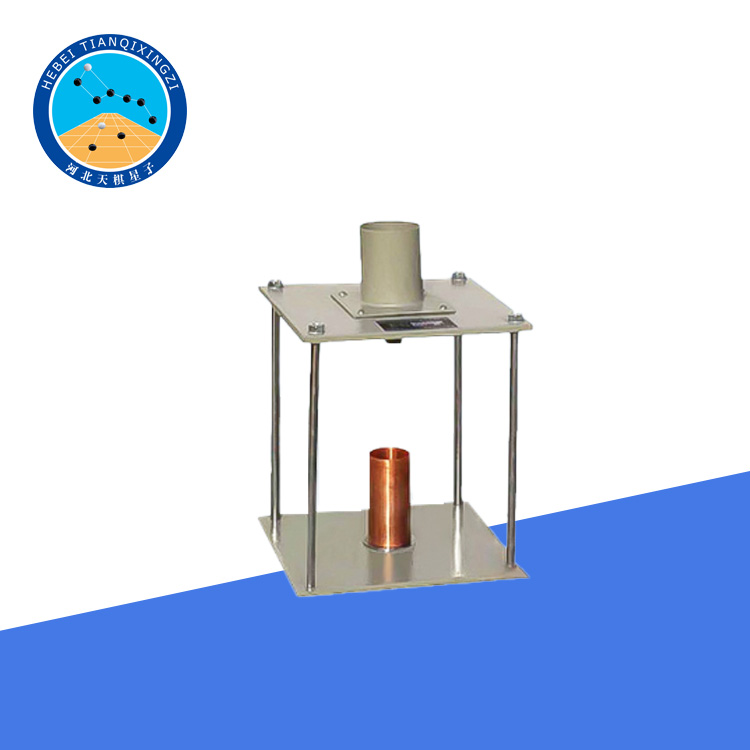

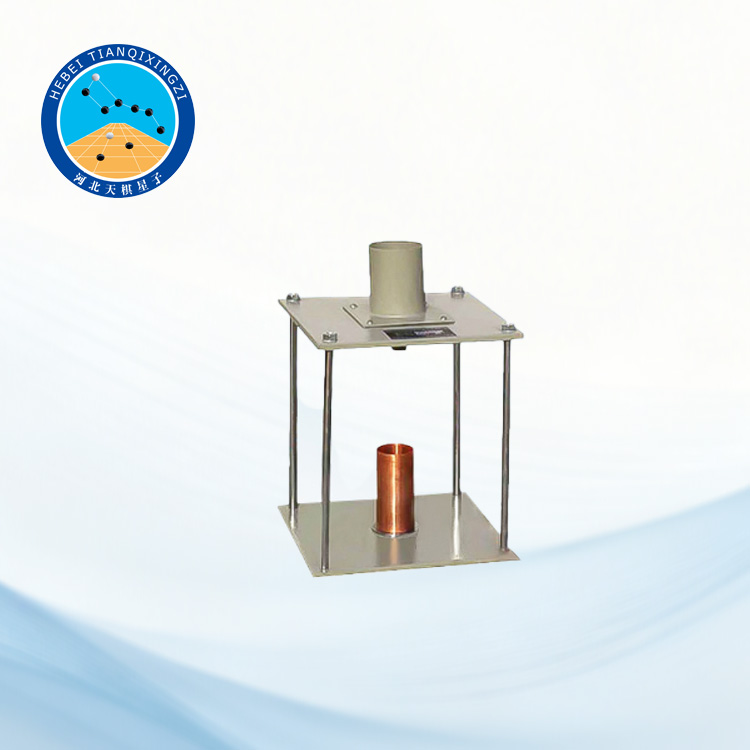
Products Description
This apparatus is designed to determine the uncompacted void content of fine aggregate by allowing a specified quantity of fine aggregate to pass through a standard funnel and fall freely into a standard container. The resulting void content, expressed as a percentage, is used to characterize the angularity of fine aggregate. It is applicable to the determination of the angularity of fine aggregates such as natural sand, manufactured sand, and stone dust used in pavement construction. The test results can be used to evaluate the potential influence of fine aggregate on the internal friction angle and resistance to permanent deformation (rutting) of asphalt mixtures.
Fine Aggregate Angularity (FAA) Test Apparatus
Model:TD344-1
I. Product Introduction
The Fine Aggregate Angularity Test Apparatus is developed and manufactured by Hebei Tianqixingzi Inspection Equipment Co., Ltd. in accordance with the Chinese transportation industry standard JTG E42-2005, Test Methods of Aggregate for Highway Engineering. The apparatus also references the following standards and test methods:
JTG E42-2005 — Test Methods of Aggregate for Highway Engineering
GB 14684-2001 — Sand for Construction
TB/T 2328-2008 — Test Methods for Railway Crushed Stone Ballast
ASTM C1252 — Standard Test Methods for Uncompacted Void Content of Fine Aggregate
AASHTO T 304 — Uncompacted Void Content of Fine Aggregate
II. Technical Parameters
Capacity Flask: > 250 mL
Funnel Angle: 60° ± 4°
Outlet Orifice Diameter: 12.7 mm ± 0.6 mm
Receiving Container Capacity: 100 mL
III. Test Procedure
3.1 Weigh the dry mass of the receiving container and record it as m.
3.2 Fill the container completely with water and weigh the mass of the container plus water. The volume of the container is then determined as V = m₁ − m₀. The effect of temperature on the density of water may be neglected at this stage.
3.3 Sieve the fine aggregate sample collected from the field using a standard sieve with an aperture size of 2.36 mm or 4.75 mm, depending on the maximum particle size of the sample, and remove particles larger than the specified maximum size. Generally, a 2.36 mm sieve is used for natural sand, manufactured sand with a nominal size of 0–3 mm, and stone dust, while a 4.75 mm sieve may be used for manufactured sand and stone dust with a nominal size of 0–5 mm.
3.4 Take approximately 2 kg of the test sample and place it in an enamel tray. Soak the sample in water for 24 hours, then carefully wash it to suspend the soil and dust in the water. Slowly pour the suspension through a 1.18 mm and 0.075 mm sieve stack in several portions, discarding the turbid water containing suspended particles. Rinse the aggregate thoroughly with clean water to remove particles smaller than 0.075 mm.
Transfer the material retained on the 1.18 mm and 0.075 mm sieves back into the enamel tray. Place the tray in an oven at 105°C ± 5°C and dry the sample to constant mass. After cooling, mix the sample thoroughly and uniformly. Using either a sample splitter or quartering method, obtain at least three test portions, each weighing 190 g ± 1 g.
3.5 Connect the funnel and cylindrical container together as one assembly, and place the receiving container beneath the funnel. Block the outlet opening with a small glass plate.
3.6 Slowly pour the test sample into the center of the cylindrical container from directly above, with the pouring height level with the top of the container. Try to distribute the sample as evenly as possible.
3.7 Remove the small glass plate blocking the funnel outlet. The fine aggregate in the funnel will immediately flow through the outlet and into the receiving container.
3.8 Use a straightedge with a sharp edge to gently strike off the surface of the aggregate in the receiving container. Do not apply any vibration.
3.9 Weigh the total mass m of the container and fine aggregate, accurate to 0.1 g.
3.10 Determine the bulk relative density b of the fine aggregate according to the method in this specification T0330.
3.11 Perform three parallel tests and take the average value as the test result of the fine aggregate density.
Appendix: Other testing instruments used in conjunction with this equipment:
TDBZS standard sieve: Square mesh sieve with an aperture of 475mm and a diameter of 2.36m.
TD1002 electronic balance: Sensitivity not greater than 0.1g.
TD101-2 type drying oven: Capable of temperature control at 105℃±5℃.
Glass plate: 60mm*60m, 4mm thick.
Scraper: Bladeed ruler, 100mm long, 20mm wide.
Others: Enamel pan, brush, etc.
