


 Spanish
 Russian
 Arabic


Products Description
The Hydraulic Concrete Compressive Creep Tester is designed to support continuous testing under controlled loading conditions, making it suitable for investigating time-dependent deformation in concrete specimens.
Automatic Hydraulic Concrete Compressive Creep Tester
Model: TDH-XBY3
I. Product Overview
The Automatic Hydraulic Concrete Compressive Creep Tester is designed to measure the time-dependent deformation of concrete cylinders under a constant compressive load, typically around 30% of the failure load. This deformation, which increases over time under sustained loading, is known as concrete compressive creep.
The instrument is suitable for uniaxial compressive creep tests on concrete specimens under constant-temperature and moisture-controlled conditions. It is manufactured in accordance with relevant water industry and national standards and meets the requirements of research institutes, colleges and universities, and departments involved in concrete design, construction, and quality inspection for conducting concrete creep tests.
II. Product Features
1. The tester is equipped with a dual self-locking hydraulic pressure jack, an automatic hydraulic control system, and a microcomputer control unit. It offers a high level of automation, easy operation, stable performance, and convenient control.
2. The system provides real-time pressure display and supports automatic pressurization, constant-pressure control, and pressure release. Manual operation is also available through the control instrument, and test data are stored in real time.
3. The user-friendly interface features Chinese-language menu prompts and a power-off memory function. If a power interruption occurs, the test can resume after the instrument is restarted.
4. The creep testing frame features a modular assembly design for convenient transportation, on-site installation, and commissioning.
5. The loading height of the creep testing frame is adjustable, allowing specimens to be stacked according to their dimensions. During periods of high testing demand, each unit can accommodate two specimens simultaneously, helping reduce equipment investment.
III. Technical Parameters
Power Supply: 380V
Maximum Test Pressure: 500 kN
Pressure Measurement Range: 0–500 kN
Relative Pressure Error: ±1%
Maximum Distance Between Upper and Lower Platens: 800 mm
Control System Dimensions: 1000 mm × 600 mm × 1200 mm (L × W × H)
Loading Unit Dimensions: 380 mm × 360 mm × 1550 mm (L × W × H)
Net Weight: Loading Unit: approx. 240 kg; Control Unit: approx. 220 kg
IV. Product Configuration
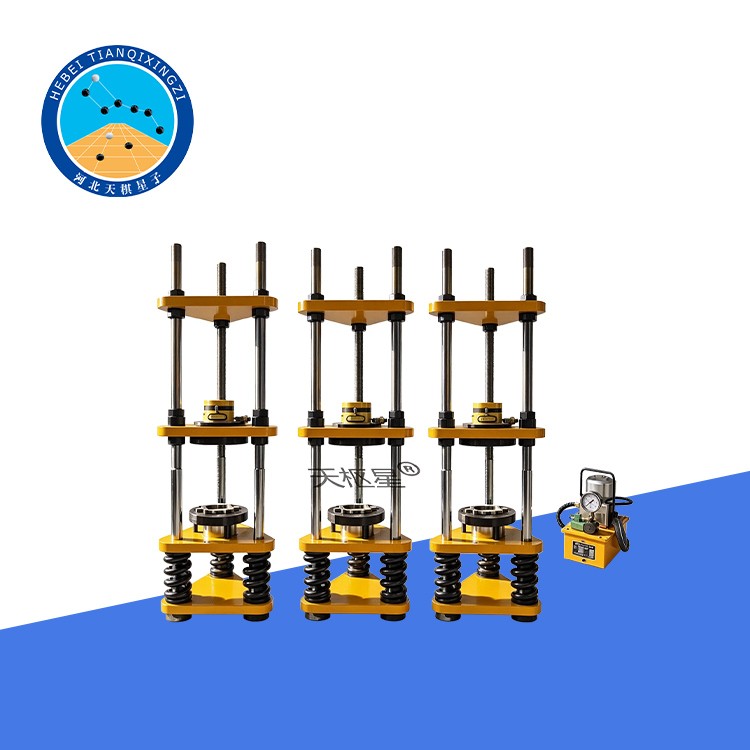
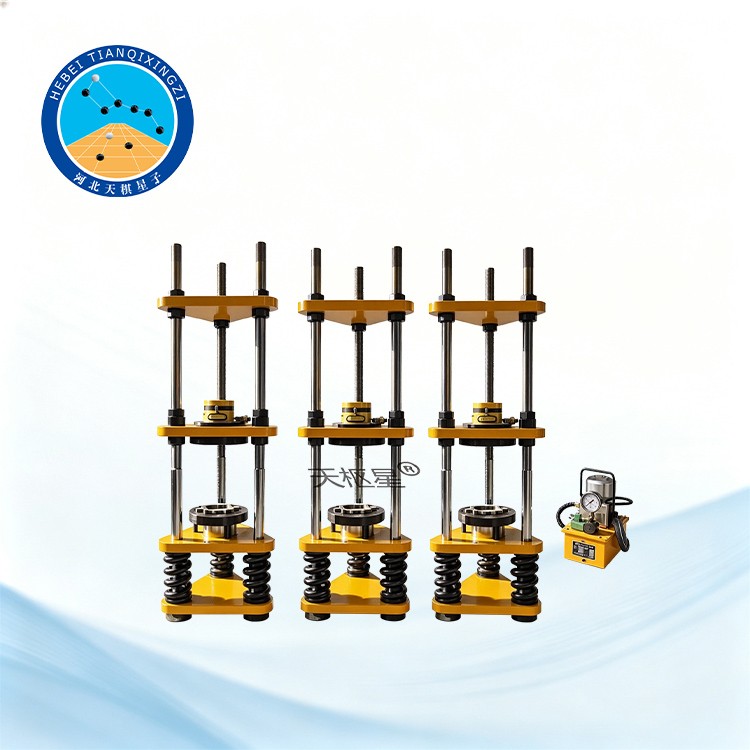
The testing machine consists of two main components: the loading unit and the control system.
1. Loading Unit
The loading unit mainly consists of a double-acting, self-locking hydraulic pressure jack, a reaction frame, and an automatic leveling system. The loading head is equipped with a movable spherical joint that automatically accommodates minor inclinations in the vertical direction caused by variations in specimen height. This ensures close contact between the upper and lower loading surfaces and the specimen, helping achieve uniform load distribution.
The loading unit is connected to the control system through two hydraulic oil hoses and pressure sensors. All operations are performed through the control system.
2. Control System
The control system mainly consists of electrical control components, an oil supply unit, an oil flow control unit, a constant-pressure control unit, and a microcomputer control unit.
Each control system is supplied as standard with three loading units, each of which can be controlled independently in either automatic or manual mode.
V. Applications
The Automatic Hydraulic Concrete Compressive Creep Tester is suitable for studying the long-term deformation behavior of concrete under sustained compressive loading. It can be used in concrete material research, structural engineering studies, and laboratory testing to evaluate the creep characteristics of concrete under specified environmental and loading conditions.
The instrument is suitable for research institutes, universities, construction material laboratories, and quality inspection organizations involved in concrete performance evaluation.
VI. Advantages of the Automatic Control System
The integrated hydraulic and microcomputer control system enables precise load adjustment and continuous pressure monitoring throughout the test. Each loading channel can operate independently, allowing multiple specimens to be tested simultaneously under different test conditions.
The automatic constant-pressure function helps maintain the specified compressive load over extended testing periods, reducing the need for frequent manual adjustments. Manual control is also available when required for setup, inspection, or operational adjustments.
