


 Spanish
 Russian
 Arabic


Products Description
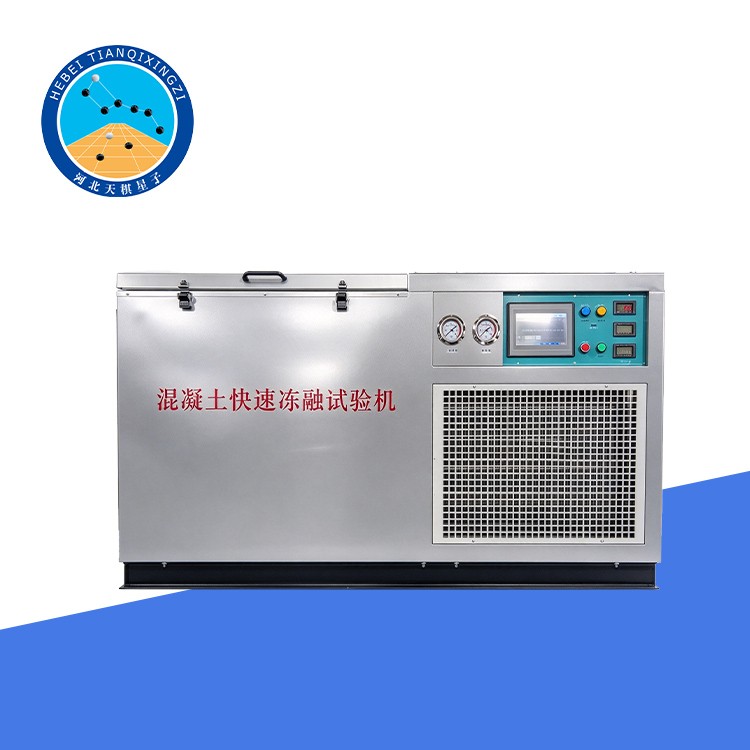
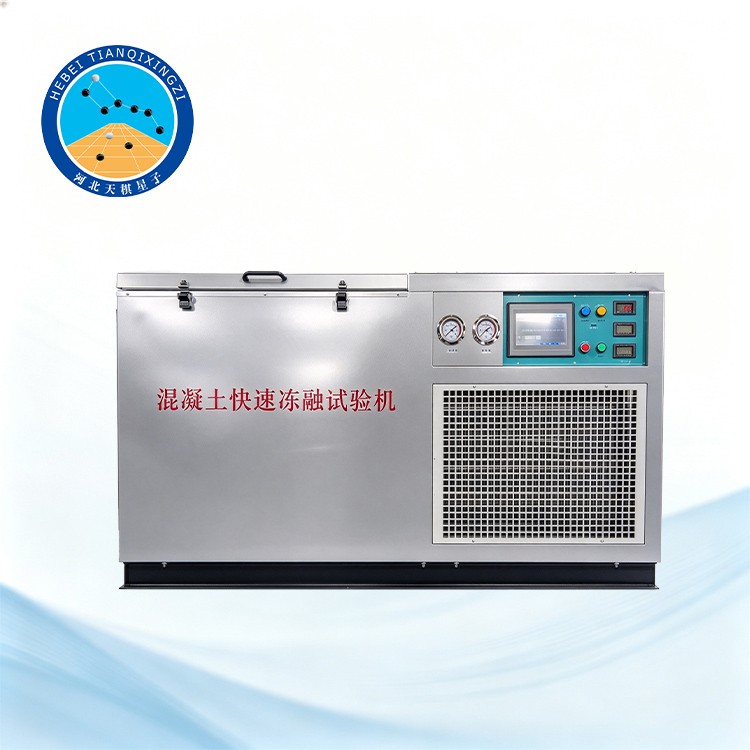
The Concrete Rapid Freeze-Thaw Testing Chamber is designed to evaluate the freeze-thaw resistance of concrete specimens by determining the number of rapid freeze-thaw cycles they can withstand under water-freezing and water-thawing conditions or by calculating their relative dynamic modulus of elasticity as an indicator of freeze-thaw durability.
Concrete Rapid Freeze-Thaw Testing Chamber
Model: TD50082-5
I. Product Introduction
The equipment is designed to meet the requirements of relevant standards, including GB/T 50082-2009, Standard for Test Methods of Long-Term Performance and Durability of Ordinary Concrete; JG/T 243-2009, Testing Equipment for Concrete Freeze-Thaw Resistance; ASTM C666, Standard Test Method for Resistance of Concrete to Rapid Freezing and Thawing; and DL/T 5150-2001, Test Code for Hydraulic Concrete.
Building on intelligent thermal energy storage technology, the concrete rapid freeze-thaw testing machine features an optimized design with a more compact structure and improved energy efficiency. It operates with reduced noise, with the maximum indoor noise level kept below 60 dB. The equipment also offers stable operating performance and reduced sensitivity to changes in ambient temperature.
It is particularly suitable for small concrete testing laboratories, research institutions conducting non-batch testing, and on-site construction testing applications where the freeze-thaw resistance of concrete needs to be evaluated.
II. Recommended Product Models
1. TD50082-10A — Integrated Concrete Rapid Freeze-Thaw Testing Chamber
2. TD50082-16A — Integrated Concrete Rapid Freeze-Thaw Testing Chamber
3. TD50082-16B — Split-Type Concrete Rapid Freeze-Thaw Testing Chamber
4. TD50082-28A — Integrated Concrete Rapid Freeze-Thaw Testing Chamber
5. TD50082-28B — Split-Type Concrete Rapid Freeze-Thaw Testing Chamber
III. Technical Specifications
(1) Concrete Rapid Freeze-Thaw Testing Chamber for 3 Groups of 10 Specimens
1. Temperature Range: -25°C to +25°C (user-adjustable)
2. Temperature Uniformity: Between measurement points (specific value not provided)
3. Measurement Accuracy: ±0.5°C; Display Resolution: 0.06°C
4. Specimen Capacity: 10 specimens
5. Overall Dimensions (L × W × H): 1300 × 850 × 900 mm
6. Total Power: 2.8 kW
(2) Rapid Freeze-Thaw Test Chamber for Cement Concrete (5-set, 16-specimen capacity):
1. Temperature range: -25°C to 25°C (user-configurable)
2. Temperature uniformity: (specified across all points)
3. Measurement accuracy: ±0.5°C; display resolution: 0.06°C
4. Specimen capacity: 16 specimens
5. External dimensions: 1700 × 800 × 1000 mm (length × width × height)
6. Total power: 3 kW
(3) Concrete Rapid Freeze-Thaw Testing Chamber for 9 Groups of 28 Specimens
1. Maximum Specimen Capacity: 9 groups + 1 central specimen
2. Temperature Range: -25°C to +25°C (user-adjustable)
3. Temperature Uniformity: Between measurement points (specific value not provided)
4. Measurement Accuracy: ±0.5°C; Display Resolution: 0.06°C
5. Specimen Capacity: 28 specimens
6. Internal Unit Dimensions (L × W × H): 1120 × 810 × 720 mm
7. External Unit Dimensions (L × W × H): 1400 × 700 × 800 mm
8. Control Cabinet Dimensions (L × W × H): 500 × 400 × 200 mm
9. Power Supply: AC 380 V / 20 A, three-phase, four-wire
10. Operating Power: 3.6 kW
IV. Working Principle
The Concrete Rapid Freeze-Thaw Testing Chamber operates by subjecting concrete specimens to repeated freezing and thawing cycles under controlled temperature conditions. During the test, the chamber automatically regulates the temperature according to the preset test program, allowing specimens to undergo repeated freeze-thaw exposure.
Changes in the specimens' physical and dynamic properties can be monitored to evaluate their resistance to freeze-thaw deterioration. The test results provide useful information for assessing concrete durability and comparing the performance of different concrete mixtures.
V. Key Features and Advantages
1. Wide Temperature Control Range: The adjustable temperature range of -25°C to +25°C supports the temperature conditions required for rapid freeze-thaw testing.
2. Automatic Temperature Regulation: The control system maintains the programmed temperature conditions throughout the test cycle.
3. Energy-Efficient Design: Intelligent thermal energy storage technology helps improve energy utilization and supports a compact equipment structure.
4. Low-Noise Operation: The optimized design helps reduce operating noise, making the equipment suitable for laboratory environments.
5. Multiple Capacity Options: Different specimen capacities are available to meet the needs of laboratories with varying testing workloads.
6. Integrated and Split-Type Configurations: Users can select the appropriate configuration according to laboratory space, installation conditions, and testing requirements.
VI. Applications
The equipment is suitable for evaluating the freeze-thaw resistance of concrete used in roads, bridges, hydraulic structures, tunnels, and other construction projects exposed to repeated freezing and thawing.
Typical applications include:
Concrete durability research and performance evaluation;
Quality inspection of construction materials;
Comparative testing of different concrete mixtures;
Laboratory research on freeze-thaw deterioration;
Quality control in concrete production and construction projects.
