


 Spanish
 Russian
 Arabic


Products Description
The product is easy to operate, offers high mixing efficiency, and is easy to clean, making it an ideal piece of concrete testing equipment for laboratory use. It is suitable for laboratories in construction research institutes, construction companies, and concrete component manufacturing facilities. It can be used for compacting ordinary concrete, lightweight concrete, and dry-hard concrete, and can also be used in laboratories across other industries for compacting various materials.
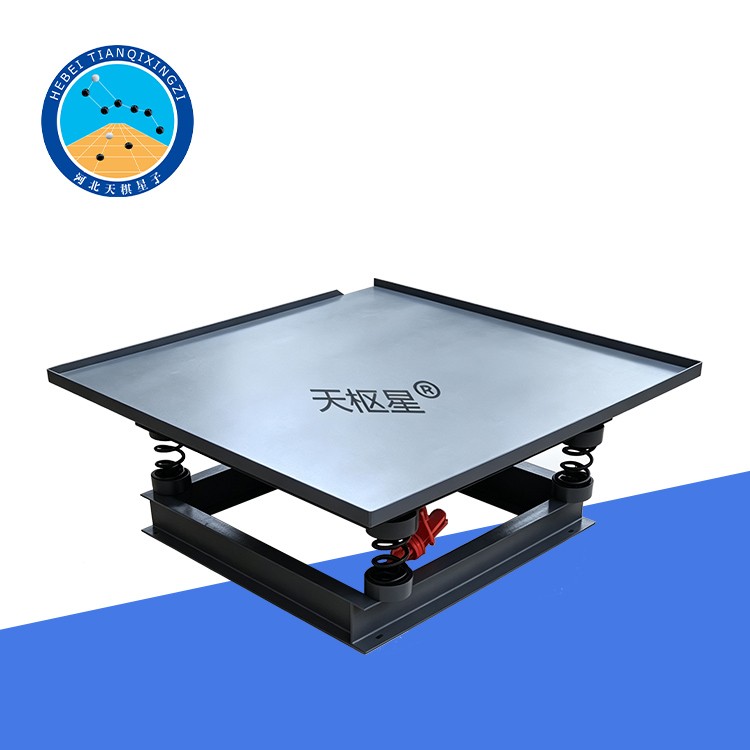
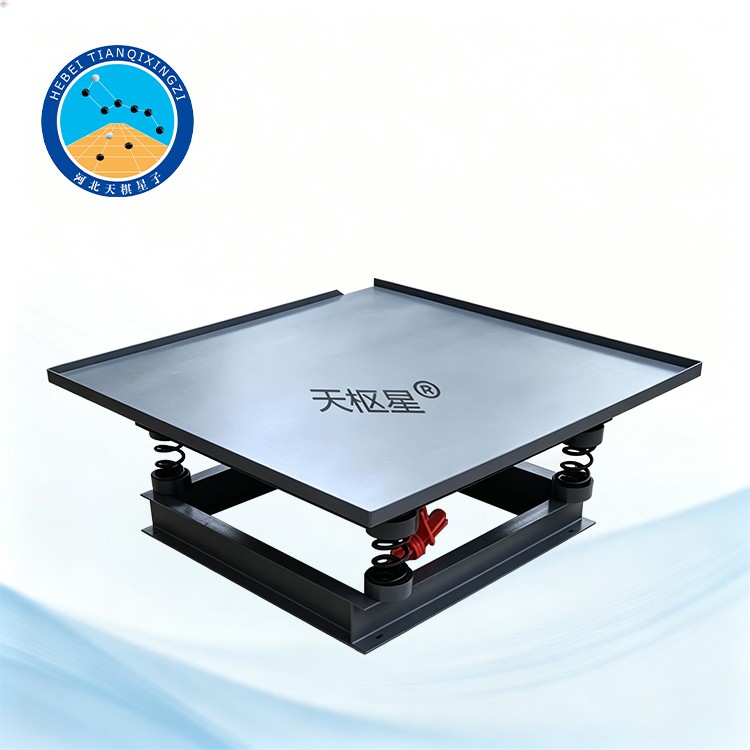
Laboratory Concrete Vibrating Table
Model: TD245-2
I. Product Introduction
The Concrete Vibrating Table is developed and manufactured by Hebei Tianqixingzi Testing Equipment Co., Ltd. in accordance with JG 244-2009, Concrete Mixer for Laboratory Use.The product meets the technical requirements for vibrating tables specified in JTG E30-2005, Test Methods of Cement and Concrete for Highway Engineering, including T0521-2005, Method for Mixing and Sampling Concrete Mixtures on Site.
Reference Standards: ASTM C192/C192M, EN 12390-2
II. Product Structure
This product is available in two models: the Standard Tabletop Vibrating Table (TD245) and the Magnetic Chuck Vibrating Table (TD245C). The following section provides a detailed introduction to the Standard Tabletop Vibrating Table (TD245).
1. Standard Tabletop Vibrating Table (TD245)
The Standard Tabletop Vibrating Table (TD245) mainly consists of a base frame, vibration springs, and other components. Both the vibrating table surface and the base frame are welded from steel plates and structural steel sections.
The vibrating mechanism consists of an electric motor and a pair of identical eccentric weights. It is installed at the center of the underside of the table surface through a pair of suspension couplings, providing stable and vertically oriented vibration during the compaction process.
III. Technical Specifications
Parameter | TD245-0.5 | TD245-0.8 | TD245-1 | TD245-2 |
Table Size (mm) | 500 × 500 | 800 × 800 | 1000 × 1000 | 1000 × 2000 |
Vibration Frequency (cycles/min) | ≈2800 | ≈2800 | ≈2800 | ≈2800 |
Amplitude (mm) | 0.3–0.6 | 0.3–0.6 | 0.3–0.6 | 0.3–0.6 |
Vibrator Power (W) | 0.55 | 1.1 | 1.1 | 3 |
Maximum Load Capacity (kg) | 75 | 200 | 250 | 500 |
Machine Weight (kg) | 65 | 140 | 200 | 370 |
IV. Applications
The Laboratory Concrete Vibrating Table is designed for compacting concrete specimens and other construction materials in laboratory environments. It is suitable for construction research institutes, quality inspection laboratories, universities, concrete component manufacturers, and construction companies.
It can be used for compacting ordinary concrete, lightweight concrete, dry-hard concrete, and other materials that require vibration-assisted compaction. The different table sizes and load capacities allow users to select a suitable model according to specimen size and testing requirements.
V. Key Features
1. Stable Vibration: The vibrating mechanism with eccentric weights provides stable and uniform vertical vibration for effective specimen compaction.
2. Robust Construction: The table surface and base frame are welded from steel plates and structural steel sections, providing a durable structure for laboratory use.
3. Multiple Model Options: TD245 series models are available with different table sizes and load capacities to meet various laboratory requirements.
4. Easy Operation: The simple mechanical structure makes the vibrating table easy to operate and maintain.
5. Wide Application: Suitable for concrete specimen compaction as well as vibration-assisted compaction of various construction materials.
VI. Suitable Materials
The vibrating table is mainly used for:
Ordinary concrete;
Lightweight concrete;
Dry-hard concrete;
Concrete test specimens;
Cement-based materials;
Other construction materials requiring vibration compaction.
