


 Spanish
 Russian
 Arabic


Products Description
Glass desiccators are widely used in petrochemical, pharmaceutical, public health, mining, metallurgical industries, university testing laboratories, and scientific research institutions. They are used for the drying and storage of hygroscopic and deteriorative chemical reagents, pharmaceuticals, precision metal components, precision instrument accessories, and laboratory glassware requiring constant weight determination.
Laboratory Glass Desiccator with Porcelain Plate
Model: TDBL-GZ18
I. Product Introduction
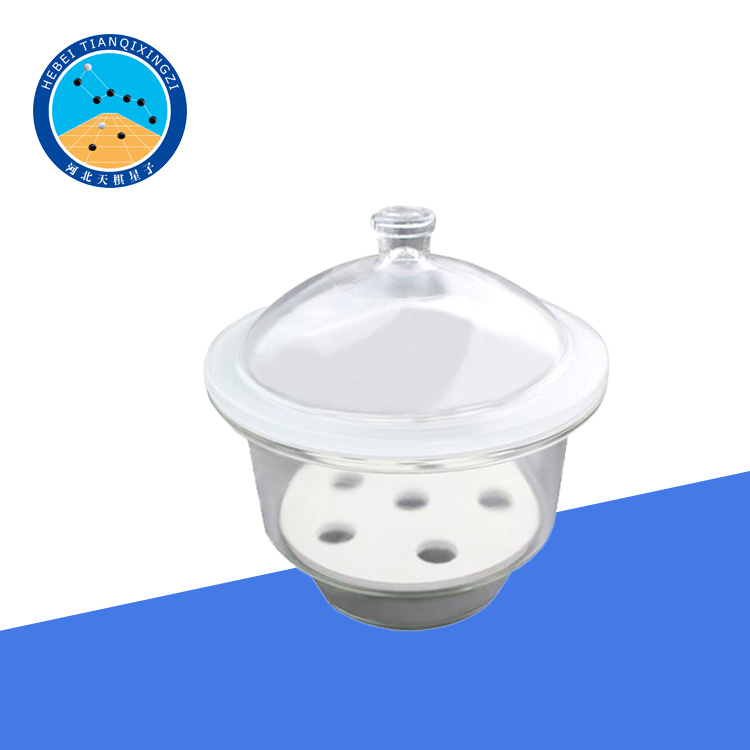
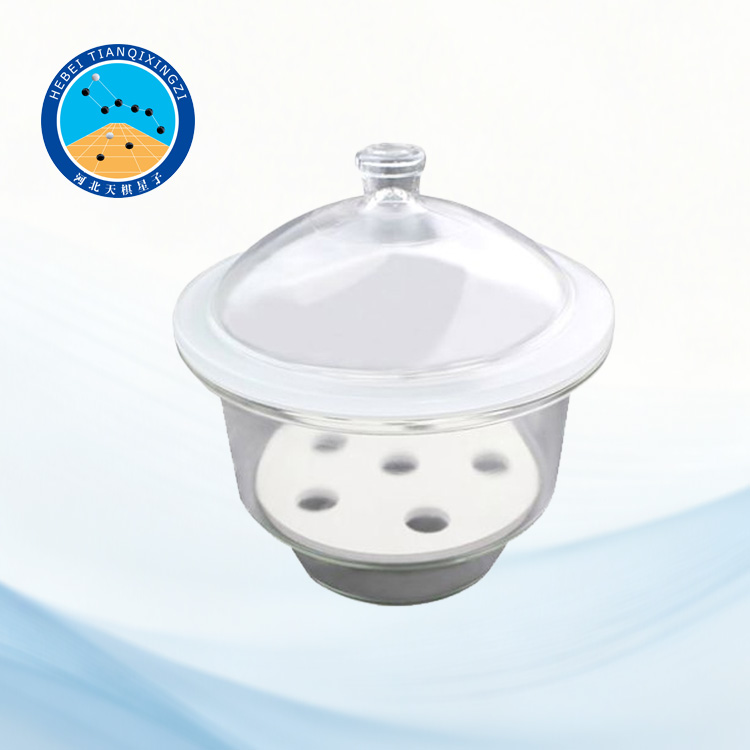
A glass desiccator is a laboratory apparatus widely used in laboratories and industrial and mining enterprises for the drying and moisture-proof storage of chemical reagents, pharmaceuticals, precision instrument components, camera lenses, and other moisture-sensitive materials. It features a wide ground-glass lid, and the lower part of the body is designed with a narrowed waist structure serving as a base for placing desiccants. Inside the waist section, there is a wide ledge used to support a perforated porcelain plate, on which the items to be dried are placed.
II. Structural Features
1. Wide Ground-Glass Lid: The lid is dome-shaped, with a round glass knob or a matching glass stopper on the top. The lid is designed with a wide ground edge that is precisely ground to fit tightly with the mouth of the desiccator, ensuring an airtight seal.
2. Waist-Contracted Design: The lower part of the body is designed with a narrowed waist structure, which serves as a base for placing desiccants. Inside the waist section, there is a circular internal ledge used to support a perforated porcelain plate.
3. Sealing Performance: After assembly, a layer of petroleum jelly (Vaseline) is usually applied to the ground-glass joint to ensure complete isolation between the internal and external air, achieving a high level of sealing.
III. Instructions for Use
Placing Desiccant and Porcelain Plate: Place the perforated porcelain plate on the internal ledge of the waist section. The items to be dried are placed on the porcelain plate, while desiccant is placed below the plate.
Sealing: After assembly, apply a thin layer of petroleum jelly (Vaseline) to the ground-glass joint to ensure airtight sealing.
IV. Common Problems and Solutions
Poor Sealing: Check whether the petroleum jelly (Vaseline) has been applied evenly and ensure that the lid fits tightly with the mouth of the desiccator.
Unsatisfactory Drying Performance: Check whether the desiccant has become ineffective or is insufficient in quantity. Replace the desiccant if necessary.
Improper Operation: Ensure that the equipment is used correctly according to the operating procedures to avoid damage caused by improper handling.
Through the above introduction, a better understanding of the structure, usage methods, and application fields of the glass desiccator can be achieved, ensuring its effective use in laboratory and industrial applications.
V. Technical Parameters
Material: High borosilicate glass / Soda-lime glass
Plate Material: Porcelain / Ceramic
Structure: Ground-glass lid + waist-body design + porcelain plate
Available Sizes: 100mm / 150mm / 200mm / 250mm / customized
Type: Standard / Vacuum type (optional)
Color: Transparent
Working Condition: Normal laboratory temperature and pressure
