


 Spanish
 Russian
 Arabic

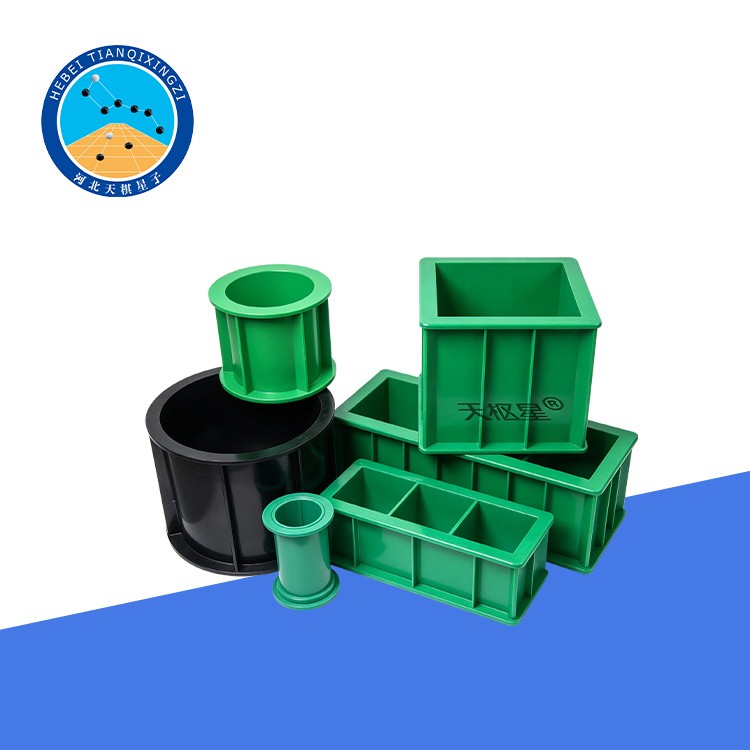

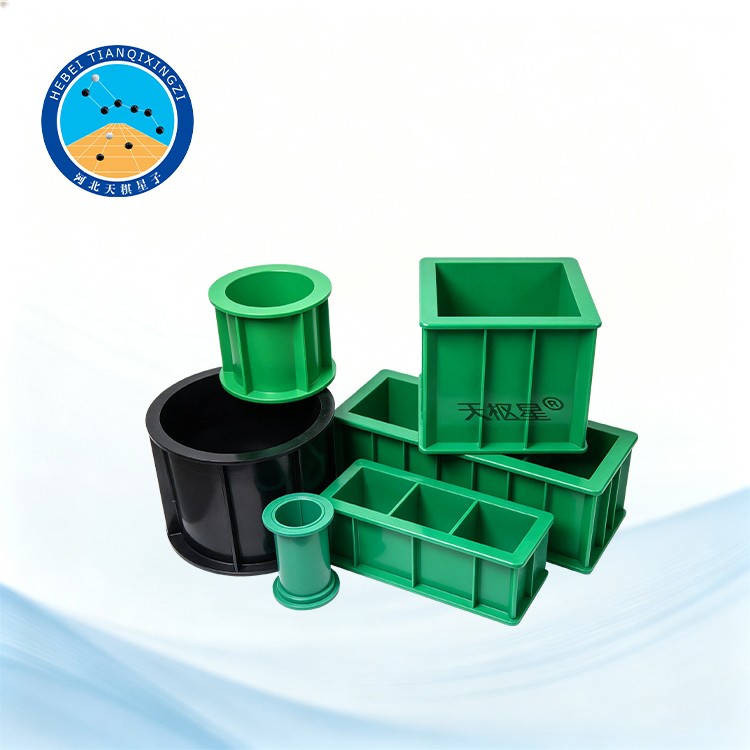
Products Description
Plastic Concrete Test Cube Mould is designed for preparing concrete cube specimens for laboratory testing and quality control. Made from durable plastic, the mould is lightweight, easy to handle, and convenient for filling, demoulding, cleaning, and repeated use.
Plastic Concrete Test Cube Mould
Model: JG237-100A
I. Product Introduction
The mould provides a practical solution for producing concrete cube specimens with consistent dimensions and stable shape, helping ensure reliable test results. It is suitable for concrete compressive strength testing, construction material laboratories, research institutes, quality inspection centers, and construction projects.
The Plastic Concrete Test Cube Mould can be used with standard concrete testing procedures and is available in different sizes to meet various testing requirements.
II. Product Features
1. Lightweight: The weight is only about 1/8 to 1/10 that of a cast iron mould of the same size, significantly reducing the operator's workload.
2. Easy Demoulding: No assembly or disassembly is required as with cast iron moulds. The mould is made as an integral unit and can be demoulded using an air pump or hand air pump. One person can complete the demoulding quickly, improving work efficiency.
3. Improved Specimen Accuracy: The plastic mould is manufactured by one-time injection moulding using a high-precision engineering plastic mould. This reduces the potential for human errors that may occur during the assembly of cast iron moulds, helping improve specimen dimensional accuracy.
4. High Strength and Wide Temperature Resistance: The engineering plastic mould offers high strength and good resistance to both high and low temperatures. It does not deform within the temperature range of −30°C to +100°C and can be used normally under these conditions.
5. Economical for Long-Term Use: The mould is suitable for long-term use and offers a low purchase cost. Its lightweight design reduces labour requirements, while eliminating the need to replace bolts and nuts commonly associated with cast iron moulds.
III. Product Specifications
1. Plastic Concrete Cube Moulds:
100 × 100 × 100 mm
150 × 150 × 150 mm
200 × 200 × 200 mm
100 × 100 × 300 mm
100 × 100 × 400 mm
2. Plastic Concrete Cylinder Moulds:
Φ100 × 200 mm
Φ150 × 300 mm
Φ100 × 400 mm
3. Concrete Permeability Test Mould:
Φ175 × Φ185 × 150 mm
IV. Applications
The Plastic Concrete Test Cube Mould is widely used for the preparation of concrete specimens in construction material testing and laboratory applications. It is suitable for concrete compressive strength testing, concrete quality control, material research, and routine laboratory testing.
The mould can be used in construction material laboratories, concrete testing laboratories, research institutes, universities, quality inspection centers, and construction projects. Different mould sizes are available to accommodate various specimen preparation requirements.
V. Product Advantages
1. Lightweight Design: Easier to transport, handle, and store than conventional cast iron moulds.
2. One-Piece Construction: The integral design eliminates the need for assembling and disassembling multiple mould components.
3. Fast Demoulding: The specimen can be removed efficiently with the help of an air pump or hand air pump.
4. Reusable: The durable engineering plastic construction allows the mould to be reused for routine laboratory testing.
5. Easy Maintenance: The smooth mould surface facilitates cleaning after specimen preparation and demoulding.
6. Multiple Sizes: A variety of cube, cylinder, and permeability test mould sizes are available to meet different concrete testing requirements.
VI. Usage and Maintenance
Before use, check the mould for damage, deformation, or contamination and ensure that the inner surface is clean. During specimen preparation, fill the mould according to the applicable test procedure and compact the concrete as required.
After demoulding, clean the mould promptly and store it in a dry and suitable environment. Avoid strong impacts or improper handling that may damage the mould. For specific specimen dimensions and testing procedures, follow the requirements of the applicable testing standard.
