


 Spanish
 Russian
 Arabic


Products Description
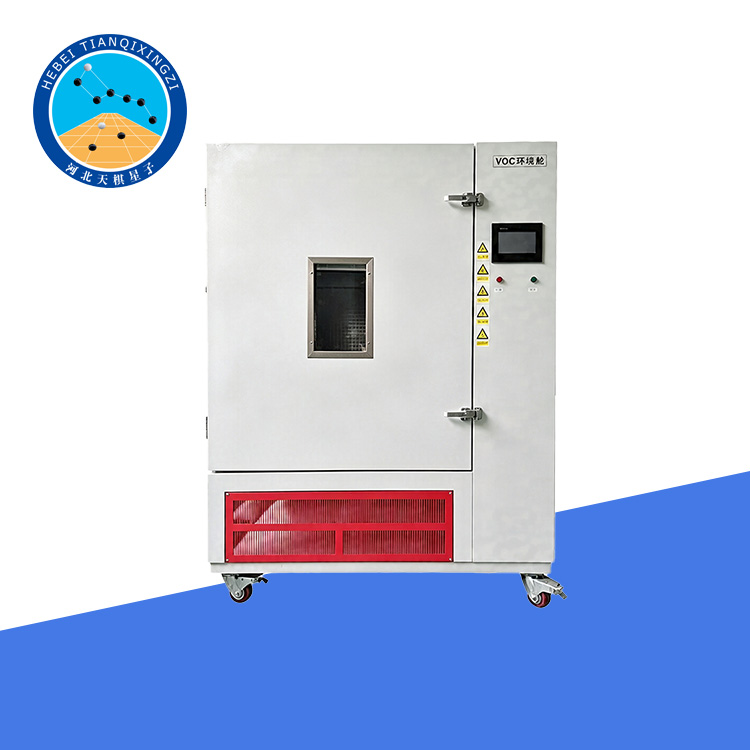
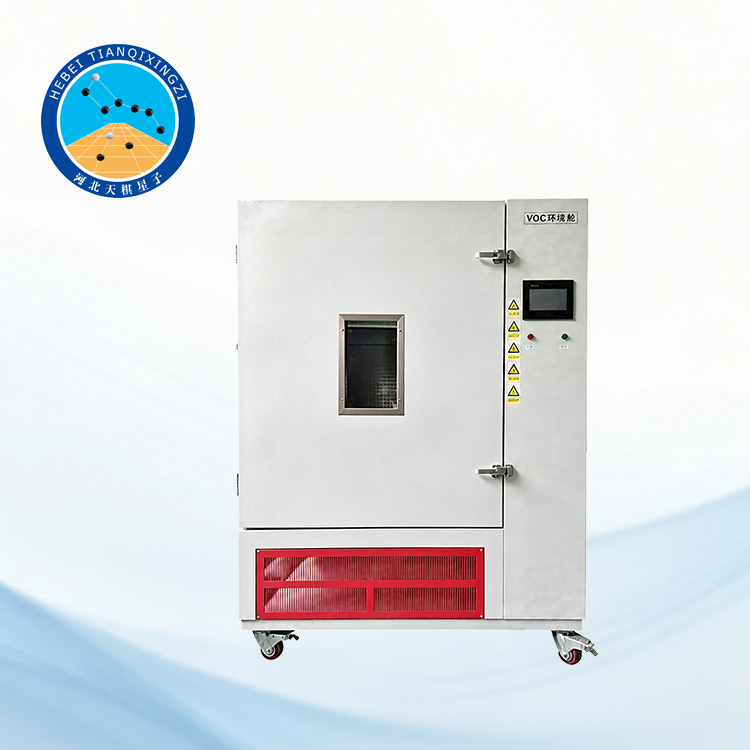
The 1m³ Formaldehyde and VOC Emission Test Chamber is designed for determining the emission of formaldehyde and volatile organic compounds (VOCs) from wood-based panels, furniture, flooring, building materials, and other indoor decorative products. It provides a stable and precisely controlled testing environment by accurately regulating temperature, relative humidity, air exchange rate, and airflow, ensuring reliable and repeatable emission test results.
1m³ Formaldehyde and VOC Emission Test Chamber
Model:TD29899-1
I. Product Introduction
The chamber is widely used in quality inspection laboratories, research institutions, universities, and manufacturing enterprises for product development, quality control, and environmental performance evaluation. It is designed and manufactured in accordance with the technical requirements of internationally recognized standards, including GB/T 29899, GB/T 17657, ASTM D5116, ASTM D6007, EN 16516, ISO 16000-6, and JIS A 1901, making it suitable for a wide range of formaldehyde and VOC emission testing applications.
II. Technical Parameters
(I) Volume and Dimensional Parameters
1. Nominal internal volume: 1000 (1±2%) liters
2. Internal dimensions (mm)
2.1 Internal width W: 850mm
2.2 Internal depth D: 1080mm
2.3 Internal height H: 1100mm
3. External dimensions (mm)
3.1 External width W: 1500mm
3.2 External depth D: 1300mm
3.3 External height H: 1960mm
(II) Temperature and Humidity Performance Parameters (Two Temperature Zones)
4. Temperature Range
4.1 Low Temperature Version: 15~40°C
4.2 High Temperature Version: 15~250°C
5. Humidity Range
5.1 Low Temperature Version: 30~80%RH
5.2 High Temperature Version: 5~80%RH
6. Temperature Deviation
6.1 Low Temperature Version: ≤+0.5°C
6.2 High Temperature Version: ≤±0.5°C (at operating temperature)
7. Humidity Deviation
7.1 Low Temperature Version: ≤+2%RH
7.2 High Temperature Version: ≤±2%RH (at operating temperature)
8. Temperature Uniformity
8.1 Low Temperature Model: ≤ +0.8°C
8.2 High Temperature Model: ≤ +0.8°C (at operating temperature)
9. Humidity Uniformity
9.1 Low Temperature Model: ≤ ±2%RH
9.2 High Temperature Model: ≤ ±2%RH (at operating temperature)
10. Temperature Fluctuation
10.1 Low Temperature Model: ≤ +0.5°C
10.2 High Temperature Model: ≤ +0.5°C (at operating temperature)
11. Humidity Fluctuation
11.1 Low Temperature Model: ≤ +2%RH
11.2 High Temperature Model: ≤ +2%RH (at operating temperature)
12. Air Exchange Rate: 0–2.5 air changes per hour
13. Airtightness: The air leakage rate inside the chamber is less than 5% of the supply air flow rate. Under a positive pressure of 1 kPa, the gas leakage amount is less than 0.5% of the chamber volume.
14. Central Air Velocity: 0.1–1.0 m/s (continuously adjustable)
15. Relative Positive Pressure: 10 ± 5 Pa
16. Spiked Recovery Rate: >80%
17. Background Concentration (mg/m³): Formaldehyde: ≤0.006; Individual VOC: ≤0.002; TVOC: ≤0.02
(III)Temperature and Humidity Control Methods
18. Temperature Control Method: Air Jacket Method (Cold and Heat Counterbalance Method)
19. Humidity Control Method: Two-Way Adjustment Method for Dry and Humidity Ratios
(IV)Material Configuration
20. Outer Shell: Q235A cold-rolled steel plate, 1.5 mm thickness, with electrostatic powder coating finish in white color.
21. Inner Chamber: SUS304 mirror-finished stainless steel, 1.5 mm thickness (8K mirror finish).
22. Insulation Layer:
22.1 Low-Temperature Model: High-density polyurethane foam + XPS insulation board.
22.2 High-Temperature Model: Mineral fiber insulation.
23. Sealing Materials: Food-grade silicone rubber and polytetrafluoroethylene (PTFE).
(V)Operation and Control System
24. Display: 7-inch color touch screen with a resolution of 800 × 480 pixels; remote control function (optional).
25. Automatic Recording Parameters: Temperature, humidity, pressure (optional), flow rate (optional), operating time, and fault records.
26. Control Method: Temperature control adopts Proportional-Integral-Derivative (PID) control; the system control is based on PLC + HMI.
27. Resolution: Temperature: 0.1 °C; Humidity: 0.1% RH.
28. Communication Interfaces: 1 × USB-A, 1 × USB-B, 1 × RS232, 1 × RS485, and 1 × RJ-45 (optional).
29. Data Storage and Recording Functions: Internal memory, USB flash drive, and SD card.
30. Water Supply Quality and Replacement Cycle: Distilled water; more than 30 days of continuous operation.
(VI)Electrical and Overall Specifications
31. Power Supply: AC 380 V (1 ± 10%), 50 ± 0.5 Hz, three-phase four-wire system with protective grounding.
32. Installed Power Capacity (kW):
32.1 Low-Temperature Model: 3.0 kW
32.2 High-Temperature Model: 7.0 kW
33. Weight (kg):
33.1 Low-Temperature Model: 350 kg
33.2 High-Temperature Model: 380 kg
34. Noise Level: ≤65 dB.
(VII)System Protection Functions
35. System Protection: The system is equipped with multiple safety protection functions, including high and low pressure protection for the refrigeration system, overcurrent protection, over-temperature protection, motor overload protection, water shortage protection, and power supply phase loss and phase sequence protection.
III. Application Areas
The 1m³ Formaldehyde and VOC Emission Test Chamber is widely used in:
Wood-based panel manufacturers
Furniture manufacturers
Flooring and decorative material industries
Building material testing laboratories
Environmental protection inspection agencies
Universities and research institutions
Third-party certification laboratories
