


 Spanish
 Russian
 Arabic



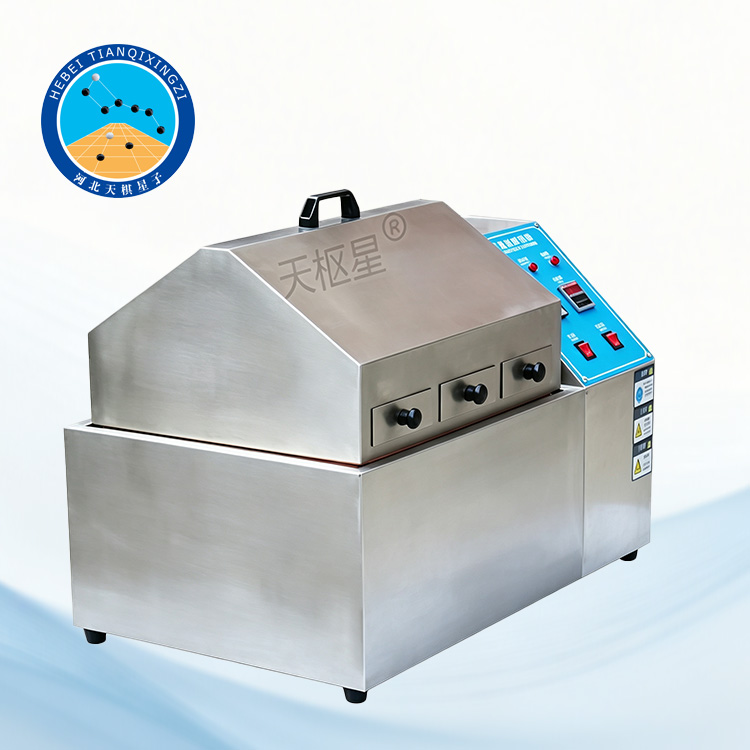
Products Description
The test specimens undergo six complete accelerated aging cycles consisting of hot water immersion, steam exposure, freezing, drying, steam exposure, and drying. After completion of the six cycles, the residual mechanical properties of the specimens, including bending strength (MOR) and screw withdrawal resistance, as well as thickness swelling and water absorption, are determined to evaluate the aging resistance and durability of the wood-based panels.
Wood-Based Panel Steam Aging Test Chamber
Model:TD17657-ZL1
I. Product Introduction
The TD17657-ZL1 Wood-Based Panel Steam Aging Test Chamber is developed and manufactured by Hebei Tianqixingzi Inspection Equipment Co., Ltd. for accelerated steam aging and durability testing of wood-based panels. It is designed in accordance with the accelerated aging test requirements specified in GB/T 17657.4.26 of GB/T 17657, Test Methods of Evaluating the Properties of Wood-Based Panels and Surface Decorated Wood-Based Panels.
The chamber is designed to evaluate the durability and aging resistance of wood-based panels under controlled steam aging conditions. It is suitable for the test procedures specified in GB/T 17657 and offers testing capabilities comparable to the cyclic aging methods described in EN 321, ISO 16983, EN 1087-1, and ASTM D1037, making it an ideal solution for laboratory quality control, research, and product development.
II. Technical Specifications
Temperature Control Range: Ambient temperature to 99.9°C
Chamber Dimensions (W × D × H): 915 × 610 × 610 mm
Heating Power: 6 kW
Temperature Control Accuracy: ±0.1°C
Power Supply: 380 V
III. Introduction to Control System Operation
1. 49°C immersion test: After selecting the “49°C immersion test,” the controller opens solenoid valve 1 to supply water to the water tank until it reaches the specified level → closes solenoid valve 1 → starts the steam generator and opens the solenoid valve.
2. The temperature in the water tank is controlled by regulating the heating of the steam generator. Timing starts for 1 hour once the water temperature reaches 49°C, and a buzzer is activated to prompt whether to proceed to the 93°C steam spray test. The water in the storage tank is drained. (If “Yes” is selected, the system directly enters the “93°C steam spray test” program. If “No” is selected, the steam generator stops operating.)
3. 93°C steam spray test
After selecting the “93°C steam spray test,” the controller opens solenoid valve 2. The water tank temperature is controlled by regulating the heating of the steam generator. Timing starts for 3 hours once the water temperature reaches 93°C. A buzzer is activated to indicate that the steam spraying process has been completed, prompting the operator to remove the specimens and place them into a low-temperature test chamber or a drying oven.
4. Test Methods
4.1 Accelerated Aging Cycles. The specimens shall undergo 6 cycles of testing. If the cycle is interrupted (e.g., at the weekend), it can only occur during freeze treatment. Each cycle includes the following steps:
Specimens are immersed in hot water at (49 ± 2)°C for 1 hour.
Specimens are exposed to steam at (93 ± 3)°C for 3 hours.
Specimens are frozen in a freezer at (−12 ± 3)°C for 20 hours.
Specimens are dried in a forced-air drying oven at (99 ± 2)°C for 3 hours.
Specimens are exposed to steam at (93 ± 3)°C for 3 hours.
Specimens are dried in a forced-air drying oven at (99 ± 2)°C for 18 hours.
After the 6-cycle accelerated aging test is completed, the specimens are placed at (20±2)℃ and (65±5)% relative humidity for at least 48 hours. Then, performance testing is performed.
4.2 In cyclic testing, specimens should be placed vertically in the specimen rack with a certain distance between them. During immersion and steam treatments, the distance between specimens and between the specimens and the container wall should be at least 25 mm to allow for free expansion. During immersion treatment, the upper end of the specimen should be (75±25) mm above the water surface.
4.3 During cyclic testing, the specimens should be frequently checked for delamination or other damage. Any obvious damage should be recorded.
